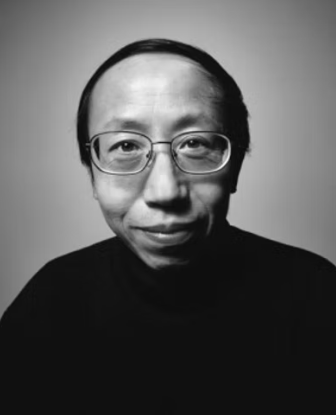
Described as an enfant terrible of Chinese contemporary art, Huang Yong Ping created provocative experimental works challenging political, social and cultural norms. He was born in Xiamen in 1954 and based in Paris since 1989, where he passed away in 2019.
Yong Ping was an indispensable figure in China’s avant-garde art movements in the early 1980s. In 1986, he and several friends established “Xiamen Dada”. His move to France happened when he participated in “Magiciens de la Terre,” a major exhibition at the Centre Pompidou. Due to his status as an immigrant and the cultural differences and collisions he experienced, his art “took on the East with the West and took on the West with the East”.
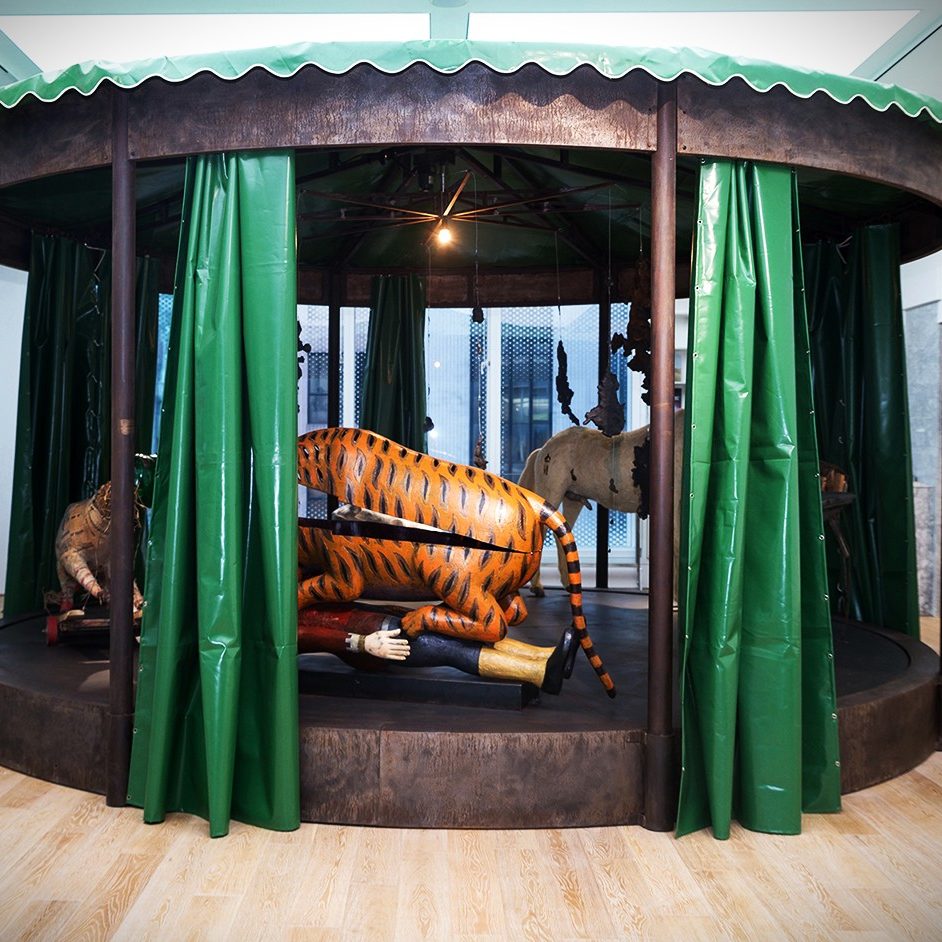
One of his most impressive works is “Les Consoles de Jeu Souveraines” (The Sovereign Gaming Consoles) that was created for an exhibition in Hong Kong in late 2017, and reflects in oblique and poetic ways on themes of territorial conquest and power. The playful, childlike quality of the installation makes the grim world of political power accessible and entertaining.

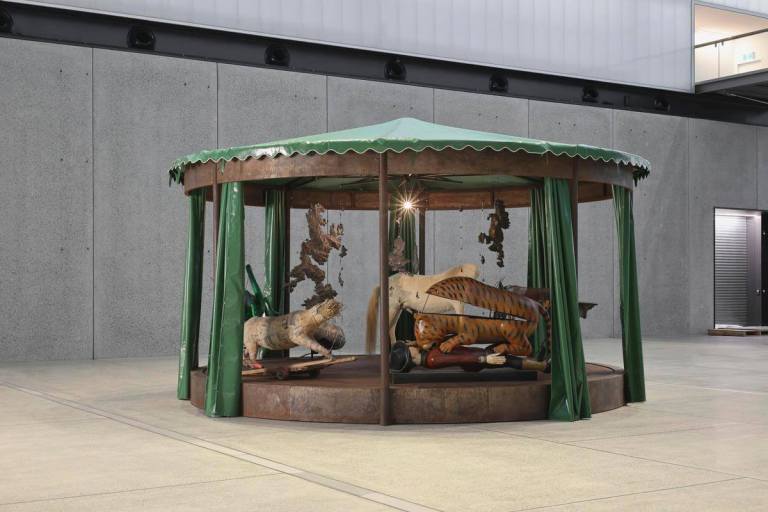
“Les Consoles de Jeu Souveraines” takes the form of an archaic decorated carousel inspired by the decaying merry-go-round that Huang Yong Ping sees from the window of his Paris studio. Two sections revolve in opposite directions – the larger one turns clockwise and the smaller counter-clockwise, making grinding mechanical noises rather than the expected cheerful hurdy-gurdy. The inner ring of the carousel contains what appears to be a cast iron topographical map of Hong Kong and its surrounding islands, hanging like weights on a scale. The outer ring is populated by seven animals, objects and a human figure.
The creatures on this carnival ride include a headless white horse; a similarly headless, straw-stuffed creature with a newspaper skin; a hollow tiger eating a fallen wooden man; a giant green locust, the metal skeleton of a headless deer, a model aircraft carrier, and a tin frog. The symbolism of this motley assembly is complex. The deer and horse, for example, refer to a Chinese idiom, ‘point to a deer and call it a horse’, meaning to misrepresent the truth. The white horse references ‘Le Vizir’, an Arab steed given by the Ottoman sultan to Napoleon in 1808.
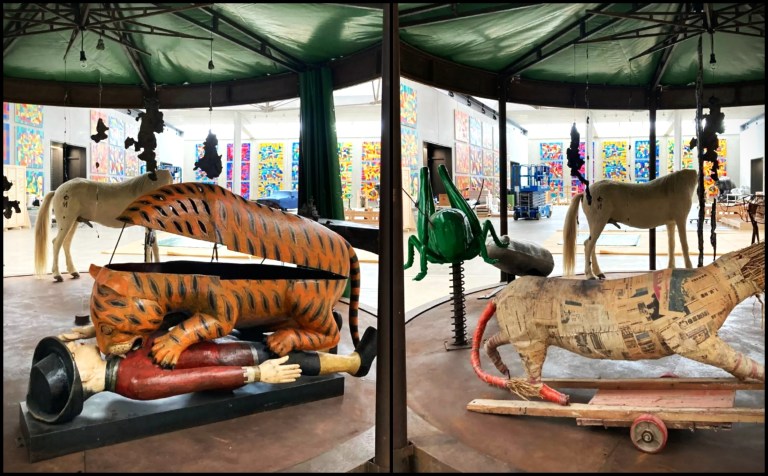
A locust represents greed, and the paper tiger is a satirical reference to British imperialism. The tiger savaging a European soldier refers specifically to ‘Tipu’s Tiger’, an elaborate mechanised wooden toy made for the eighteenth-century ruler of the Indian Kingdom of Mysore, which is now in the Victoria and Albert Museum in London. This extraordinary artefact expressed Tipu’s hatred of the British and the predations of the East India Company. Given the role of the Company in the Opium Wars, and the subsequent annexation of Hong Kong, it is a potent symbol here, revolving like the painted horse on a merry-go-round.
Huang Yong Ping studied painting at the Zhejiang Academy of Fine Arts (now the China Academy of Art) in Hangzhou just after the Cultural Revolution, graduating in 1982. Yong Pong’s work has been shown in major exhibitions and museums around the world for the last two decades. He represented France in the 48th Venice Biennale in 1999; his travelling retrospective “House of Oracles” was shown at Walker Art Center, Minneapolis (2005), Massachusetts Museum of Contemporary Art (2006), Vancouver Art Gallery (2007) and was received with critical acclaim. His recent solo exhibitions include “Bâton Serpent” at MAXXI, Rome (2014); “Bâton Serpent III: Spur Track to the Left” at Power Station of Art, Shanghai (2016); “Empires” at Monumenta 16, Grand Palais, Paris; and the group show “Art and China after 1989: The Theater of the world” (2017) in New York’s Solomon R. Guggenheim Museum.
.
.
.

 On Art and Aesthetics