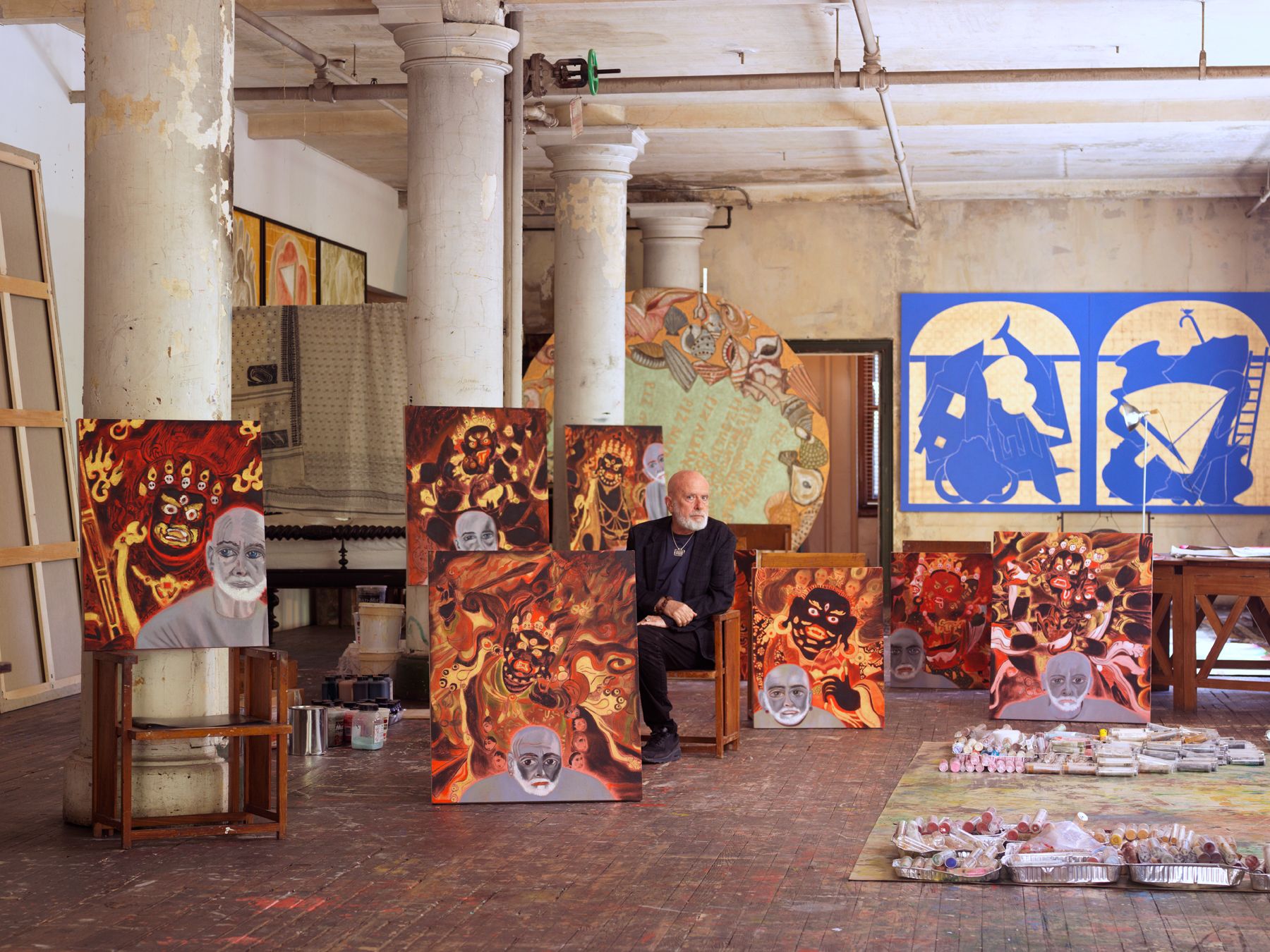
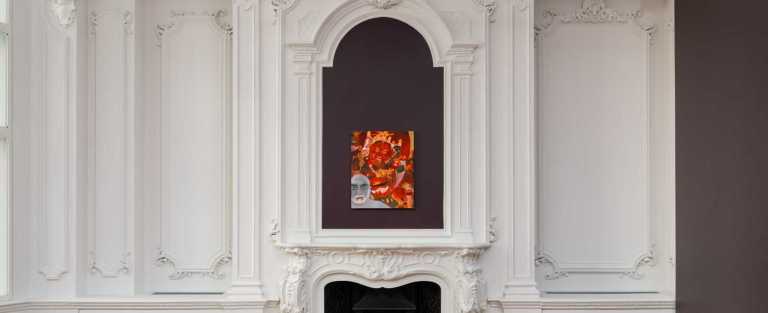
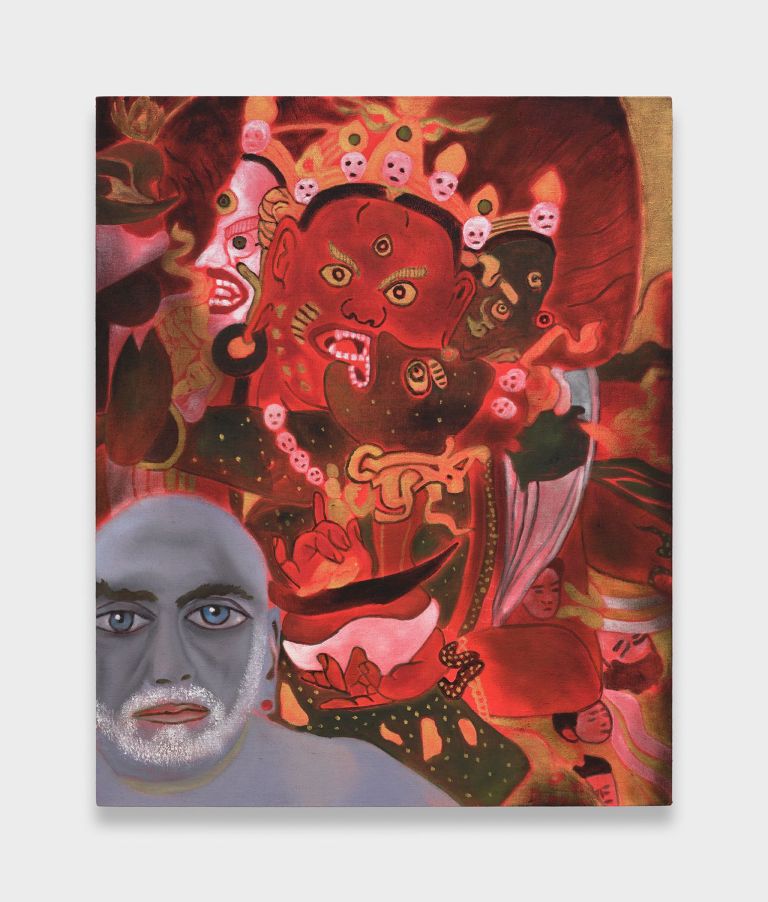
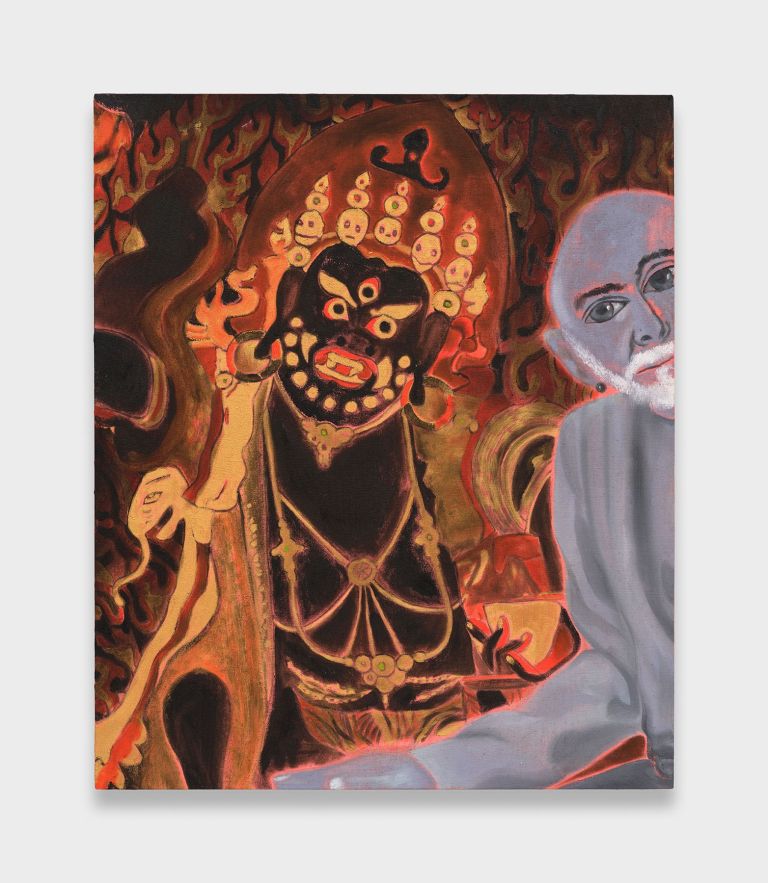
Running from June 26-September 27, 2025 at Lévy Gorvy Dayan in London, “Self-Portraits in the Bardo” featured eight vivid and visionary canvases by Italian artist Francesco Clemente wherein the painter’s personal imagery was fused with Tibetan Buddhist representations of the “bardo” or antarābhava. A central concept in the Himalayan religion, it describes a liminal state of consciousness associated with the moment between death and rebirth.
On each canvas, Clemente creates a contrast between his grisaille self-portrait in the foreground and the richly hued background, where the deities of the bardo manifest in kaleidoscopic arrangements of form and colour. The paintings speak to the pursuit of spiritual guidance and deliverance—and to Clemente’s belief in art as a unique vehicle for insight and enlightenment. The fiery energy behind the grey face and form appears to promise a powerful and mysterious reality beyond the fact of human vulnerability, aging and disintegration.

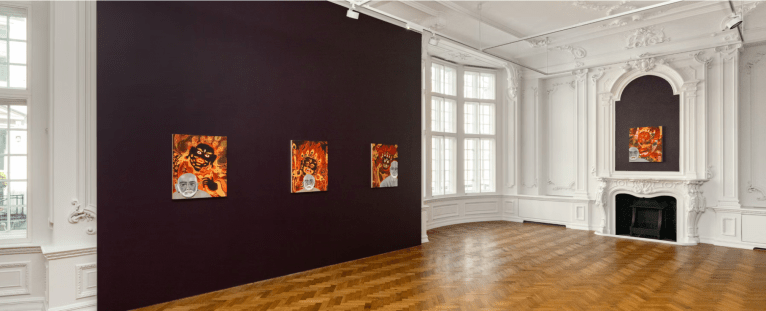
Clemente elaborates on the concept of the “bardo”, calling it “a place in between lives, but also a place in between affirmation[s] of being.” Recounting an experience he had at the age of nineteen, Clemente notes perceiving “a gap, an absolute emptiness” before the recurrence of “the simple feeling ‘I am’.” For the artist, the bardo, in this sense, is a fundamental part of experiencing life and identity. He has approached the idea throughout his oeuvre, most notably in his self-portraits, which he has described as “homage[s] to the bardo”—reflecting an idea of self that is not static but discontinuous and metamorphic.
For more than six decades, Francesco Clemente has forged a singular career that seeks intercultural resonance, addressing the philosophical dualities of mind and body, freedom and constraint, and part and whole. In paintings, prints, frescoes, photography, book editions, and installations, he nurtures a signature poetic intensity, using metaphor and symbolism to consider the nature of the self. Dividing his time between New York, Chennai (formerly Madras) and Varanasi, India, Clemente is inspired by the Tantra traditions of India and Tibet, Beat poetry, the ritualism of Joseph Beuys, and Greco-Roman art. His frequently collaborative practice has been linked to the Italian Transavanguardia group of the late 1970s as well as New York’s concurrent neo-expressionism. Clemente frequently turns to portraiture and has painted, among others, Jean Michel Basquiat, Toni Morrison, and Jasper Johns.
Born in Naples, Italy, in 1952, Clemente studied architecture at the Sapienza University of Rome. Following his participation in the 1980 Venice Biennale, he was critically lauded as a leader of the “return to figuration.” In 1981, with his wife Alba, he relocated to downtown Manhattan, where he collaborated with such figures as Basquiat, Andy Warhol, Allen Ginsberg, and Rene Ricard. He founded the imprint Hanuman Books with Raymond Foye in 1986, and in 1998, he created the portraits that were featured in Alfonso Cuarón’s film Great Expectations. Since he was nineteen, the artist has spent significant time in India, studying Sanskrit, literature, and collaborating with local artisans.
Links: Website (www.francescoclemente.net/)

.
.
.

 On Art and Aesthetics