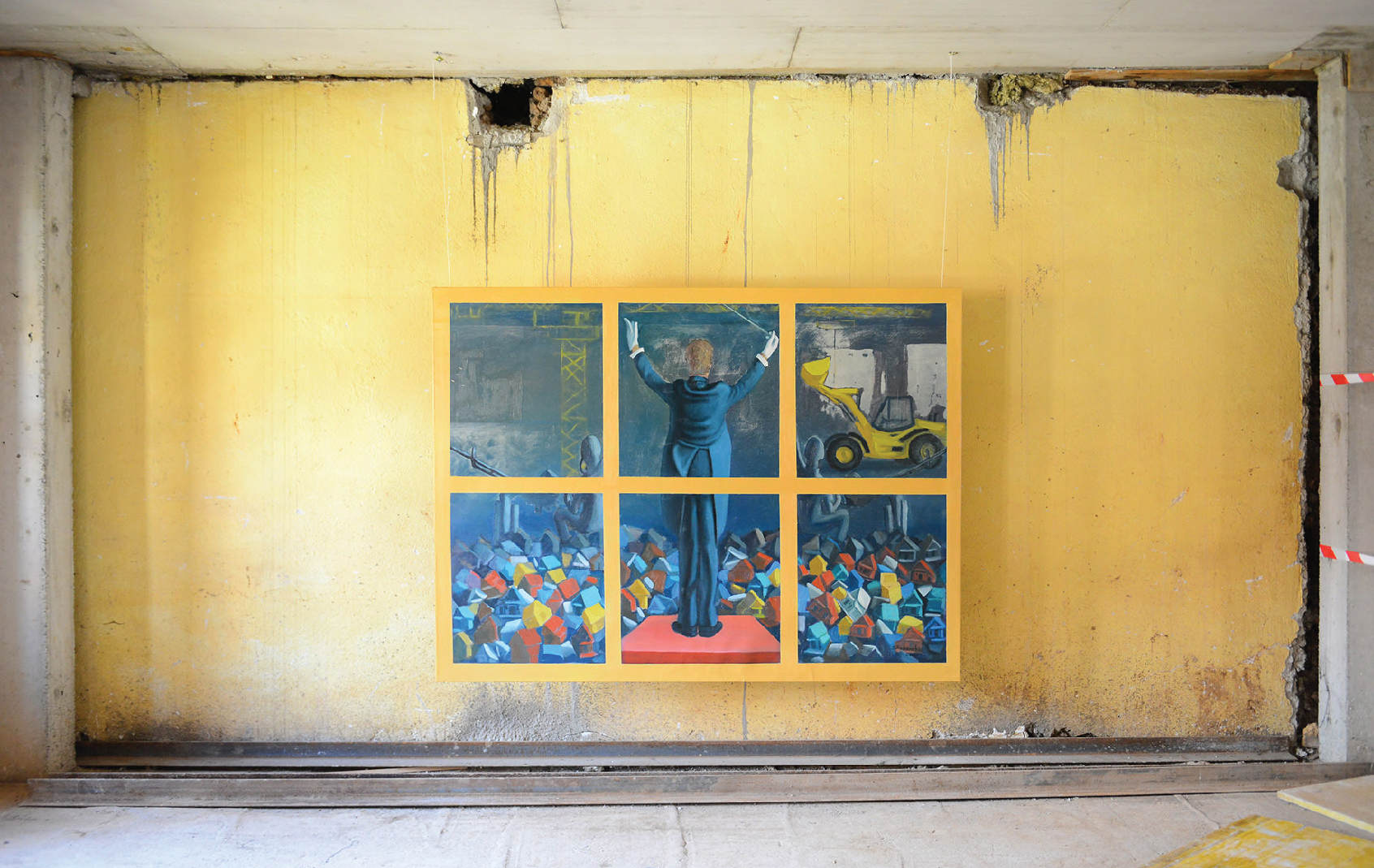
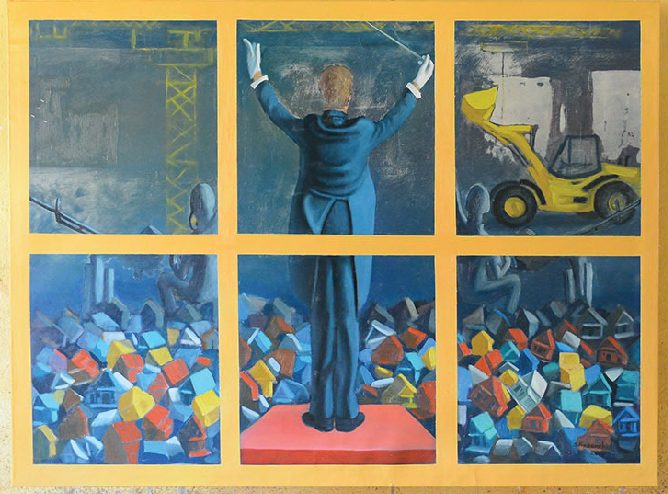
“The sound of a bulldozer, the sound of the police stepping in the house, and the sound of the roof that is falling down, turns into my music. The music that is composed for me. The territorial symphony is the symphony that follows the forced eviction of the Romani people in Europe.” – This is the explanation given by Sead Kazanxhiu, an Albanian Roma/Romani artist for his powerful and dramatic painting “Territorial Symphony” (2014). The exonym for the Roma people is “gypsy” – sometimes considered offensive. In the artwork, we see the back of classical music conductor on a piece of red floor. Before him are several little houses – blue, white, red, yellow – like toys carelessly thrown around. In the distance, a yellow bulldozer is ready to crush the houses upon the command of musical notes. A sad reality is conveyed through humour and vividness, immediately arresting the viewer.

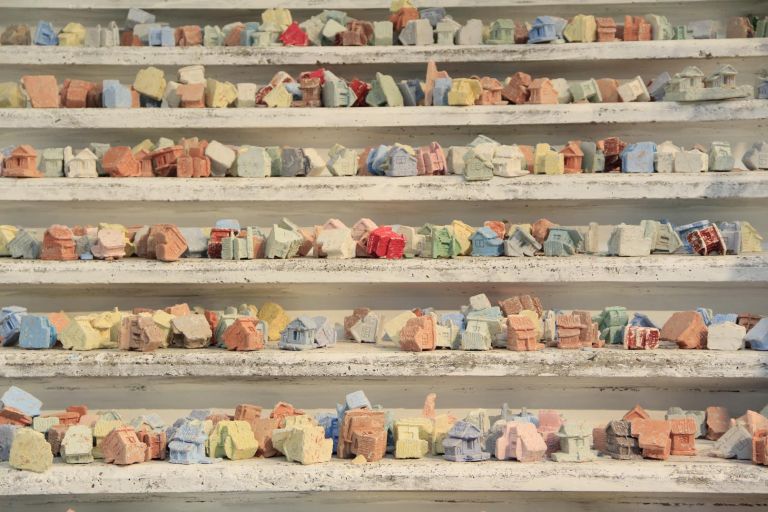
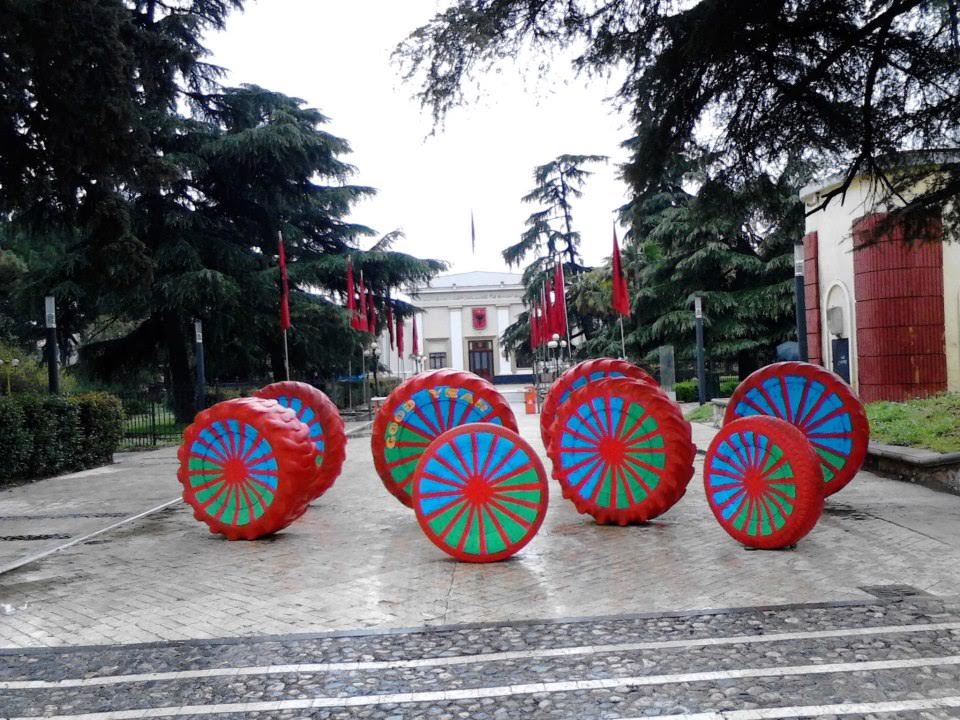
In the same year he made this painting, Kazanxhiu walked to Albanian Prime Minister Edi Rama’s office and placed 2,500 miniature pastel houses outside. These were part of a protest meant to express the artist’s frustration over the fact that 60 Roma families in the Albanian capital of Tirana had been displaced a year before and continued to lack permanent residences. Even years later, the families were living in caravan homes provided by an NGO. But Kazanxhiu’s small protest plaster houses found a place at the European Roma Institute for Arts and Culture (ERIAC) in Berlin, Germany.
The Roma, or Romani people – who are believed to have arrived in Europe from northern India a thousand years ago – are Europe’s largest minority. Many struggle with extreme poverty on the margins of society. “The Romani people never had an institution to cultivate the Romani culture,” Kazanxhiu says. “The only institution that we had was our families. We couldn’t read about ourselves in books; in literature, we would find only stereotypes. Finally, we will have an institution to stimulate Romani culture, art and language.”
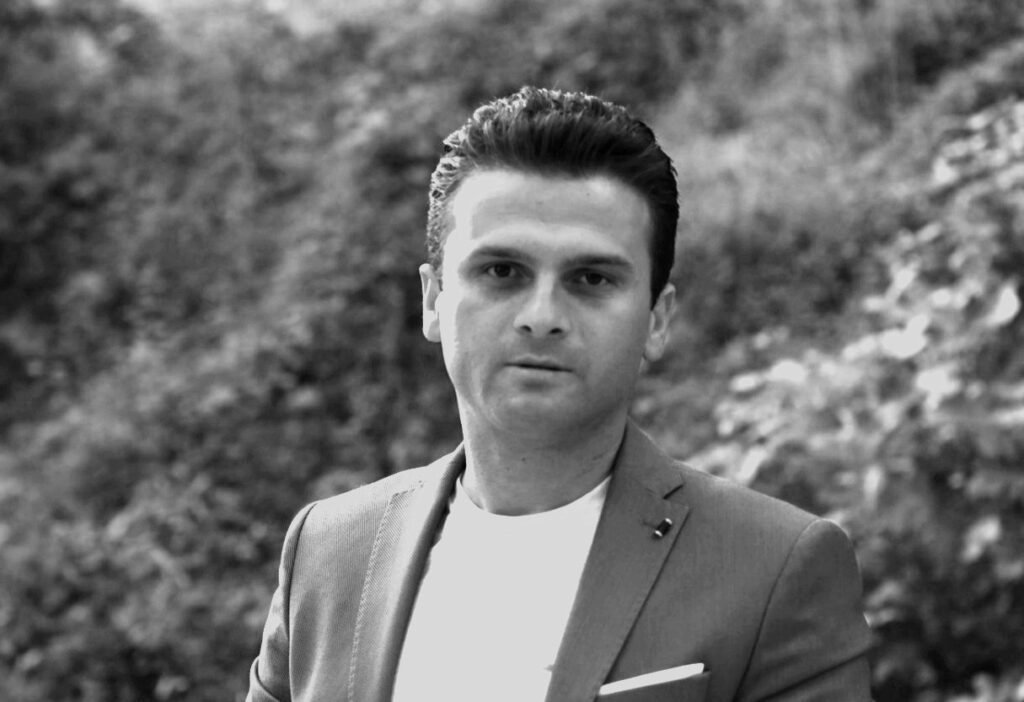
Sead Kazanxhiu (born in 1987) hails from Fier in southwest Albania. He was trained as a painter at the University of Arts in Tirana. He lives and works in Tirana, continuing to make art highlighting how social and political hierarchies lead to unequal privileges. Regarding his use of colour in his art, he writes: “There is this traditional saying: don’t respond in the same way that they speak to you. But in this case, I am answering in the same way that they are expecting, giving people the colours they are expecting from a Roma artist.”
Links: Website (https://seadkazanxhiu.wixsite.com/visualart) | Instagram (www.instagram.com/seadkazanxhiu/)
.
.
.

 On Art and Aesthetics