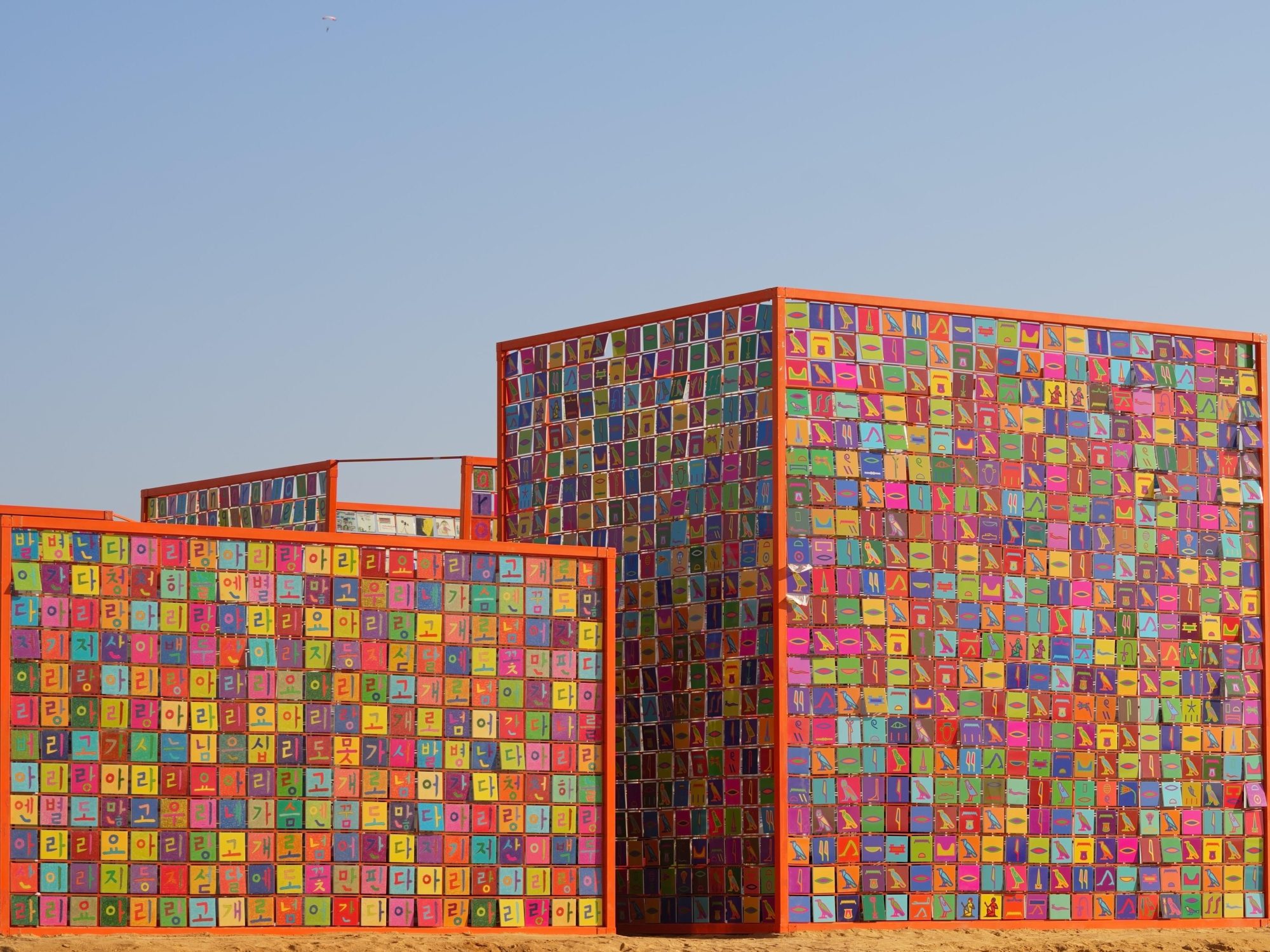
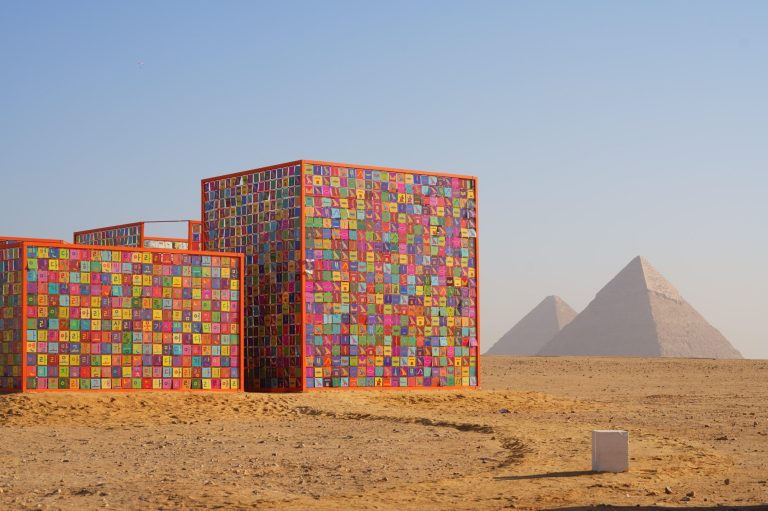
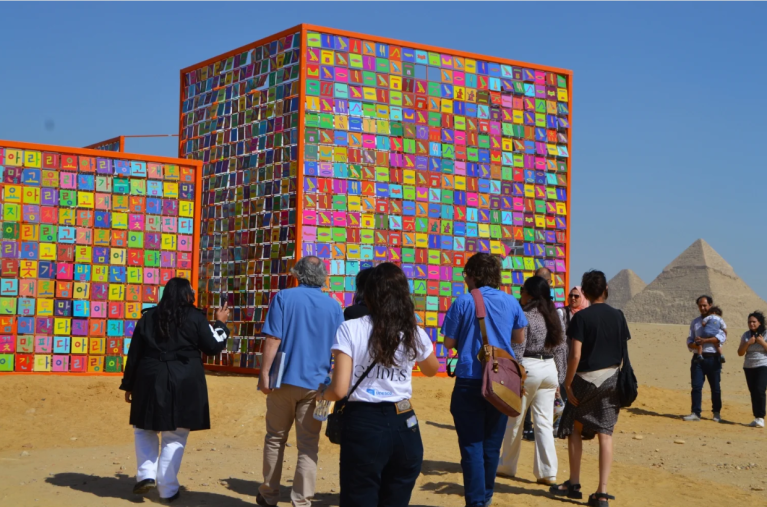
A particularly interesting piece at the 2024 “Forever is Now” exhibition at the Pyramids of Giza was “Four Temples” by Korean artist Ik-Joong Kang (born 1960), exploring themes of the past (the pyramids) and the future (dreams of people worldwide).
In this work—inspired by his visit to Cairo in 2023—Kang integrates architectural elements of Egyptian temples into the arrangement of four structures externally made up of small colourful squares carrying symbols and alphabets from different cultures, ancient Egyptian and contemporary Korean most easily visible. The installation shares the belief that, despite the divisions and conflicts on Earth, harmony and peace can be achieved through communication and exchange. The work stands out immediately because of its simplicity and inventiveness.

The outer walls of the work feature the Korean folk song ‘Arirang’ written in Hangeul (the Korean Alphabet), English, Arabic, and hieroglyphs, signifying the importance of language in bridging the past, present, and future. Although Korea is divided into North and South, ‘Arirang’ is sung by people in both regions. Kang often incorporates the distinct themes of ‘harmony,’ ‘connectivity,’ ‘empathy,’ and ‘peace.’
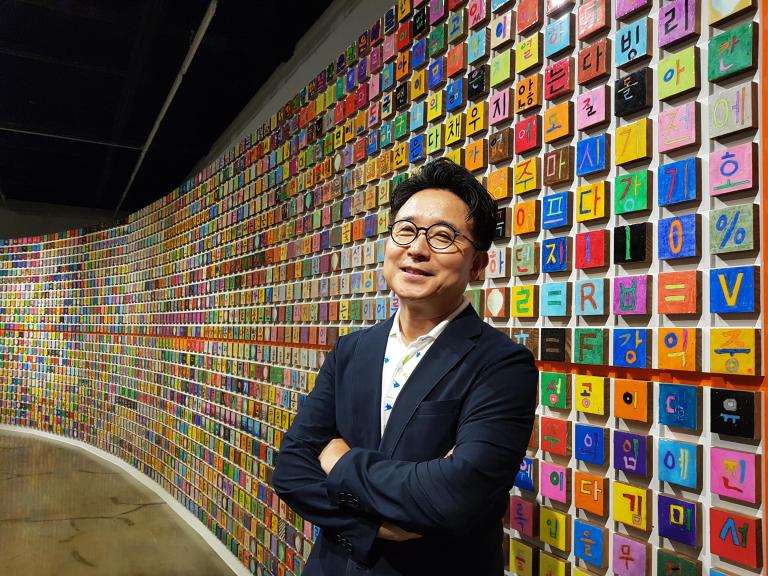
Hangeul, his preferred subject, symbolises these themes as separate characters, vowels, and consonants that come together to form complete words. The inner walls of the work are composed of drawings by people from around the world, particularly children and those facing political and social difficulties. By sharing the dreams and challenges of many, we find healing. The work includes a participatory experience through excavation. The audience digs through the sand to find two types of buried bookmarks with the words ‘love’ and ‘peace’ written in the four languages, which they can take away with them.
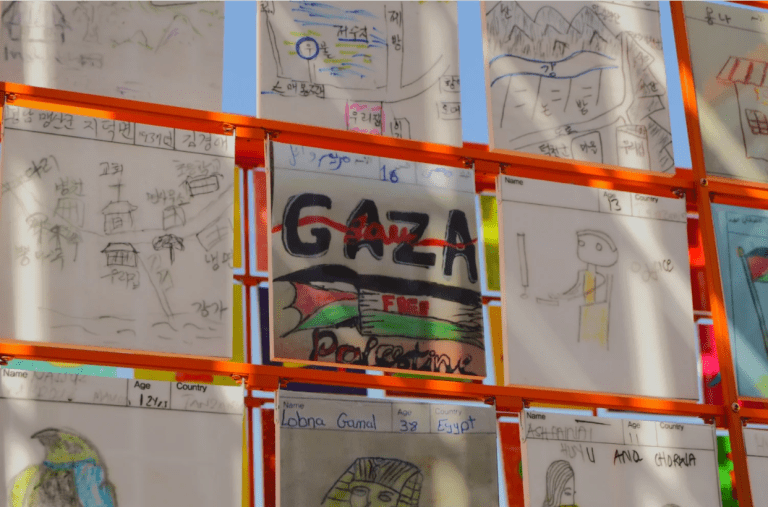
Ik-Joong Kang has gained global recognition as an artist since he moved to New York from Seoul in 1984. During this first year, it was difficult to find the time to paint, as his daily routine involved working part-time for 12 hours while attending school. Thus, he needed a solution and found one: creating small canvases which he could carry in his pocket, hold in his palm, and work on during subway rides. This invention marked the beginning of his 3-inch works, which initially captured the essence of his daily life through observing the interactions around him, as a tourist; snippets of scenes, fragments of the everyday, and vocabulary memorisation.
Kang has retained the motif and used it to consistently create artworks embodying themes of peace and harmony. In 1997, a year before his son’s birth, he began collecting drawings done by children. His project 100,000 Dreams (1999–2000) aimed to unite the divided country of Korea through children’s dreams, displaying 60,000 drawings from South Korea near the DMZ border. Amazed World (2001–2002), exhibited at the UN in New York, featured 34,000 children’s drawings from 149 countries.
“Four Temples” has been possible with the support of the YS Kim Foundation, the Peter Magnone Foundation, Hyundai Rotem, Lee International, Margarette Lee, and ENART.
Links: Website (ikjoongkang.com/) | Instagram (www.instagram.com/ikjoongkang)
.
.
.

 On Art and Aesthetics